
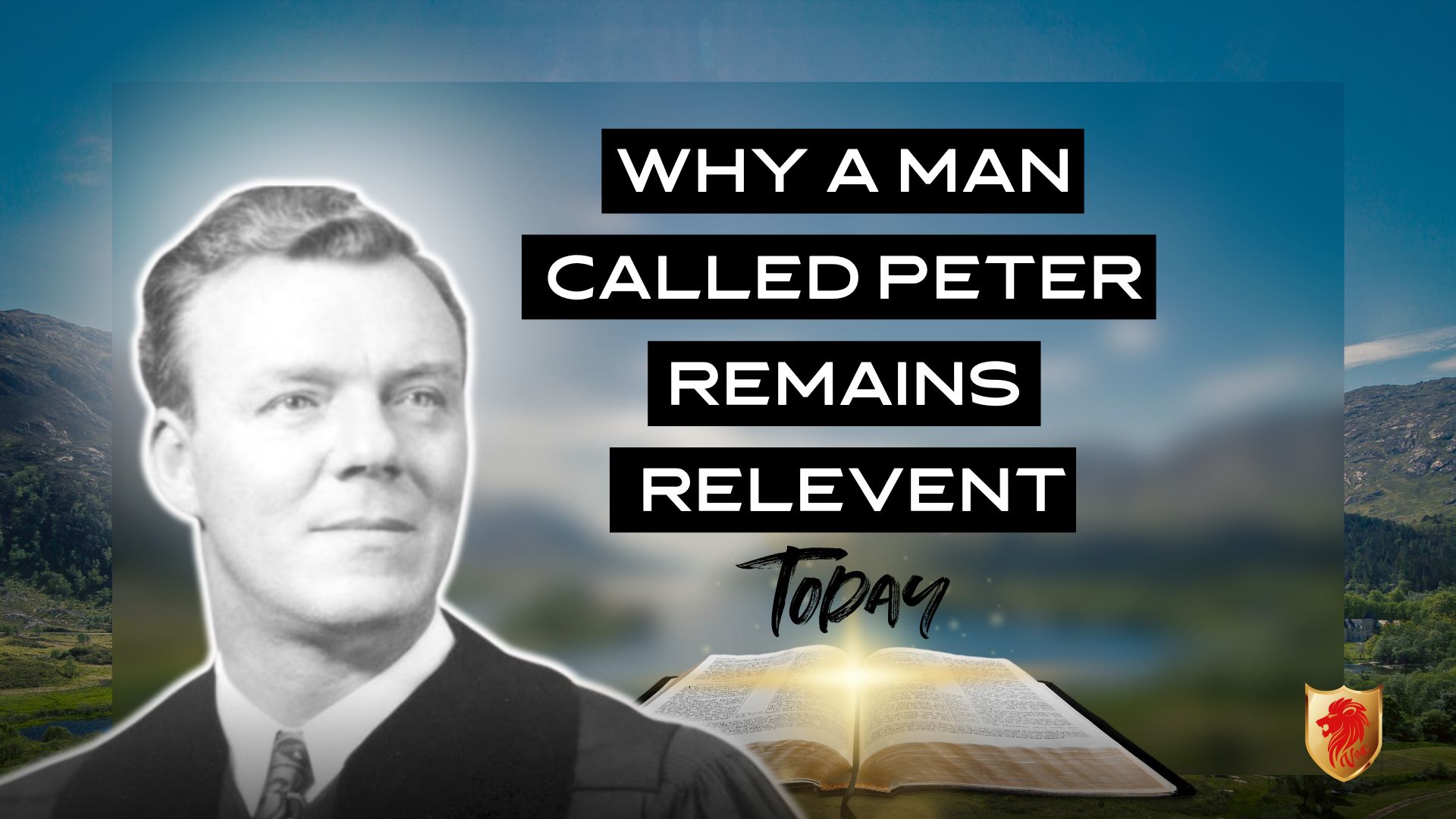
The 1955 movie, A Man Called Peter, begins by showing Peter Marshall when he was a child hiding in
a wooden crate on the pier of his hometown so he could go out to sea, but he was quickly discovered by the sailors and sent back home. He was yearning to leave the tiny Scottish town he lived in called Coatbridge and ended up becoming a missionary for America.
Sometimes, we have desires and dreams that God placed on our hearts, and we don’t understand why we hold them inside until God clearly tells us what purpose they have for His Kingdom.
That’s what happened to Peter Marshall, both in real life and in the movie, A Man Called Peter. Once he traveled over to the States in 1927, he didn’t become a great minister of a large church in Washington, DC, right away. He worked his way up from mining during the day and going to a technical school at night to eventually studying at a seminary school. Once he did become a minister, he first preached at a much smaller church in Covington, Georgia, where he eventually met his wife, Catherine. Let us not skip the small beginnings because we think we’re too skilled to start at square one.
David was a shepherd when he was a boy, then as a man, he became the King of Israel. But there were many steps in between shepherd and king for him. It was the same way with Peter Marshall, and if we lay down our pride, it can be the same way with us, too.
Since Peter Marshall became a preacher, there have been a lot of short sermons in this movie. I named them myself since I couldn’t find the actual names of all these sermons. There’s also one speech spoken by Catherine. I’m going to give a summary of each of his sermons and how they are significant scenes in the film, A Man Called Peter.
Sermon #1; “The Haunting Wistful Fragrance of Violets”
(Peter’s Words, Not Mine)
His first sermon was in First Presbyterian Church in Covington, Georgia, where his words, well-orchestrated like the symphonies he was referencing, caught the eye of his future wife. The sermon itself is about how many invisible aspects of life are real, like “the haunting wistful fragrance of violets,” beauty, love, the human soul, and most importantly, God, yet none of them can be explained by logic. When I watched this scene, I noticed an important yet small detail that brilliantly foreshadows the rest of this movie.
When Peter Marshall was discussing love, he asked as an example of questioning if the invisible can be real: “When will I know I’m in love?” And he followed up with (my
paraphrase): “No matter who I’ve asked, everyone told me that you’ll just know.”
Everyone else chuckled in their pews except Catherine, Peter’s future wife. She fell in love with him just by listening to his words.
Catherine’s Speech
The context of this speech is that college students are meeting at some field for a youth rally, and Peter was there. Everyone else is too scared to speak in front of a large audience, but not Catherine, a senior at Agnes Scott College. She boldly stands up on top of the back of a pickup truck as her soapbox to speak about how women have been socially engineered to think and act more like men, which often leads to negative habits and sinful hearts.
From a historical perspective, this makes sense because this movie takes place in the 1930s, after the hardships of World War I and the Great Depression. Women started to act more like men because, at first, they had to. Many women had to provide for their families all by themselves for the first time. When many husbands and boyfriends became missing in action or died in the war, many women’s hearts became rock hard and ice cold, to the point where it was and is extremely common to tell racy jokes, smoke cigarettes, and drink alcohol to get drunk, especially to capture the attention of
men – all vices that Catherine pointed out in her speech.
In other words, Catherine wanted to urge women to protect the beauty in their souls, which made women desirous of men in the first place, the beauty of who God created them to be.
Catherine said that Mary, the mother of Jesus, began the first emancipation of women and not the twentieth century. After all, Mary was appointed by the Heavenly Father to give birth to the Messiah. No equal rights reforms can ever equal what the Holy Spirit can do through us.
Sermon #2: Not the “Mamby-Pamby” Jesus:
Soon after Peter and Catherine got married and celebrated their honeymoon, they moved to Washington, DC, where he would preach at New York Avenue Presbyterian Church, where Abraham Lincoln once sat and listened. Peter started his first sermon by saying that he wanted to honor the history of the church while making it accessible to more than just the small group of elites in Washington, DC.
Marshall pointed out that Jesus invited societal outcasts to follow him, and so should this church. He also explained that Jesus wasn’t weak, afraid, and “mamby-pamby” (as Peter remarked).
Sometimes, Jesus had to be bold, like when He flipped over the tables of the thieves in the Temple. His sermon bothered a few stuffy, elderly elites who grew up in this church, but quite a few people liked it, including a senator who was visiting Washington DC, and a granddaughter of one of the elites. Some churches don’t focus nearly enough on bringing ALL people to Jesus.
Sermon #3 A Boy Named Kenneth:
It was during World War II – at least 100 men in uniform from the Annapolis Naval Academy filled the pews of Peter’s church. He had a sermon prepared, but he decided not to speak it. Instead, he spoke about what God told him about a sickly boy named Kenneth.
Peter told a story of this boy who asked his mom, “Mother, what is it like to die?” His mother gives him a beautifully haunting answer (paraphrase):
“You know when you get so tired that you plop on my bed to fall asleep, and then your dad carries you back to your room? When you wake up, you know where you’re supposed to be, your own room. That’s what death is like.”
Peter’s analogy made sense, though. It was used to comfort the soldiers listening to his sermon who would soon face the global aftermath of the bombing of Pearl Harbor.
This sermon was given by the real Peter Marshall, and it was called “Go Down Death.”
Sermon #4: A Simple Step of Faith:
Catherine was lying in her bed feeling hopeless because she prayed to God to take away her tuberculosis, and it didn’t work. She was listening to her husband preach on the radio.
He was preaching about the woman who took a simple step of faith to allow Jesus to cure her disease. She raced through the crowds to touch His garment. When Catherine took a simple step of faith by rushing down the stairs to greet her husband, her tuberculosis was healed.
Sermon #5: An Interrupted Sermon:
When Peter and his family got back from vacation, he had a heart attack as he was standing on his pulpit and beginning to preach. A sudden thud on the wooden floor signaled everyone, including his wife Catherine and his young son Peter John, to check if he was okay.
Soon after Peter fell, he was rushed to the hospital. But a few days later, he recovered and was sent home. However, there were some conditions – no sudden loud noises, no excitement. He wasn’t even allowed to walk up and down the stairs of his own house. He couldn’t stand how dull and lifeless his home life was, so he arranged to play Bridge with his wife and some senator that night.
Sermon #6: Materialism or God?
This sermon, named “Trial by Fire,” feels just as relevant to the 1950s as it does today. Peter was calling out the materialism of American culture prevalent in the 1950s, as well as, as he put it, “modified immorality, modified dishonesty,” which is just as prevalent today. He related America’s struggle between materialism and godliness by explaining the story of ancient Israel’s struggle between choosing God or Baal. Elijah declared: “Whoever can get their god to burn the sacrifices from thin air wins” (my summary, not Peter’s), knowing that His God is the God of Abraham, Isaac, and Jacob would win.
The Baal worshippers danced around to get their god to burn their sacrifice, yet no fire came. When Elijah prayed to the one true God, the sacrifices burst into flames immediately. Peter was making the point that we need to choose who our god is as a nation – the one true God or Baal. Some in America have chosen Baal, but until Jesus comes back, it’s not too late for any nation to change.
Soon after the sermon, Mrs. Fowler forgave Peter for making the church inclusive to all social classes rather than exclusive to elites like her by giving him an item from John Paul Jones, a Scottish naval officer who served in the American Revolution. Only moments later, he agreed to be a chaplain for the United States Senate.
Unfortunately, Peter had another heart attack. Peter was ready to leave the Earth and enter Heaven. The last words he spoke to his wife before he died on January 26, 1949, were: “See you in the morning,” while the rest of the nation was mourning his loss. Newspapers all over the United States showed the headline: “Peter Marshall dies.” A senator who was touched by Marshall’s sermons spoke aloud the last prayer that Chaplain Marshall wrote. His life was and is one worth honoring.
Final Thoughts on a Man Called Peter, a Vintage, Family-Friendly Biopic
I love A Man Called Peter because the spirit of this film is as joyous as the vivid color seen throughout. It’s one of the few movies that has received approval from God and man. This movie earned five million dollars in total at the box office and it was the most successful film at the Australian box office in 1955. It also was one of the top ten films of the New York Times film critics for that year. I highly recommend this Twentieth Century Fox flick to anyone wanting to watch a vintage, family-friendly, and Christian biopic.
References:
The Presbyterian Outlook. (2002, July 8). Peter Marshall and a woman called Catherine. https://pres-outlook.org/2002/07/peter-marshall-and-a-woman-called-
catherine/
Murrell, S. E. (2019, June 3). “Mother, what is it like to die?” Redeeming Grace Ministries. https://stanmurrell.org/2019/06/03/mother-what-is-it-like-to-die/ Jones, Dr. N. E. (2024, August 7). Trial by fire: A sermon by Peter Marshall: The Christ in prophecy journal. The Christ in Prophecy Journal | A Lamb & Lion Ministries Blog –
Proclaiming the Soon Return of Jesus Christ.
https://christinprophecyblog.org/2024/08/trial-by-fire-a-sermon-by-peter-marshall/ Turner Classic Movies. (2011, August 29). A man called Peter. (1955) – Turner Classic
Movies. https://www.tcm.com/tcmdb/title/82559/a-man-called-peter#articles- reviews?articleId=445848

Abigail Guarnieri
Writer
Abigail Guarnieri lives in Lakeland, Florida, which is halfway between Tampa and Orlando. She loves spending time with both her parents and grandparents. In her free time, she also enjoys running, kickboxing, biking, writing short stories and poetry, and learning graphic design software like InDesign, Photoshop, Premiere Pro, and Illustrator. Most importantly, she is a servant and a child of the Most High God.


I especially loved the statement regarding Catherine being healed from her disease as she rushed to greet her husband thinking only of him and not herself or her illness. Keep reviewing movies etc.